Admissions Open 2026-2027. Apply Now Admissions Open 2026-2027. Apply Now Admissions Open 2026-2027. Apply Now Admissions Open 2026-2027. Apply Now Admissions Open 2026-2027. Apply Now Admissions Open 2026-2027. Apply Now

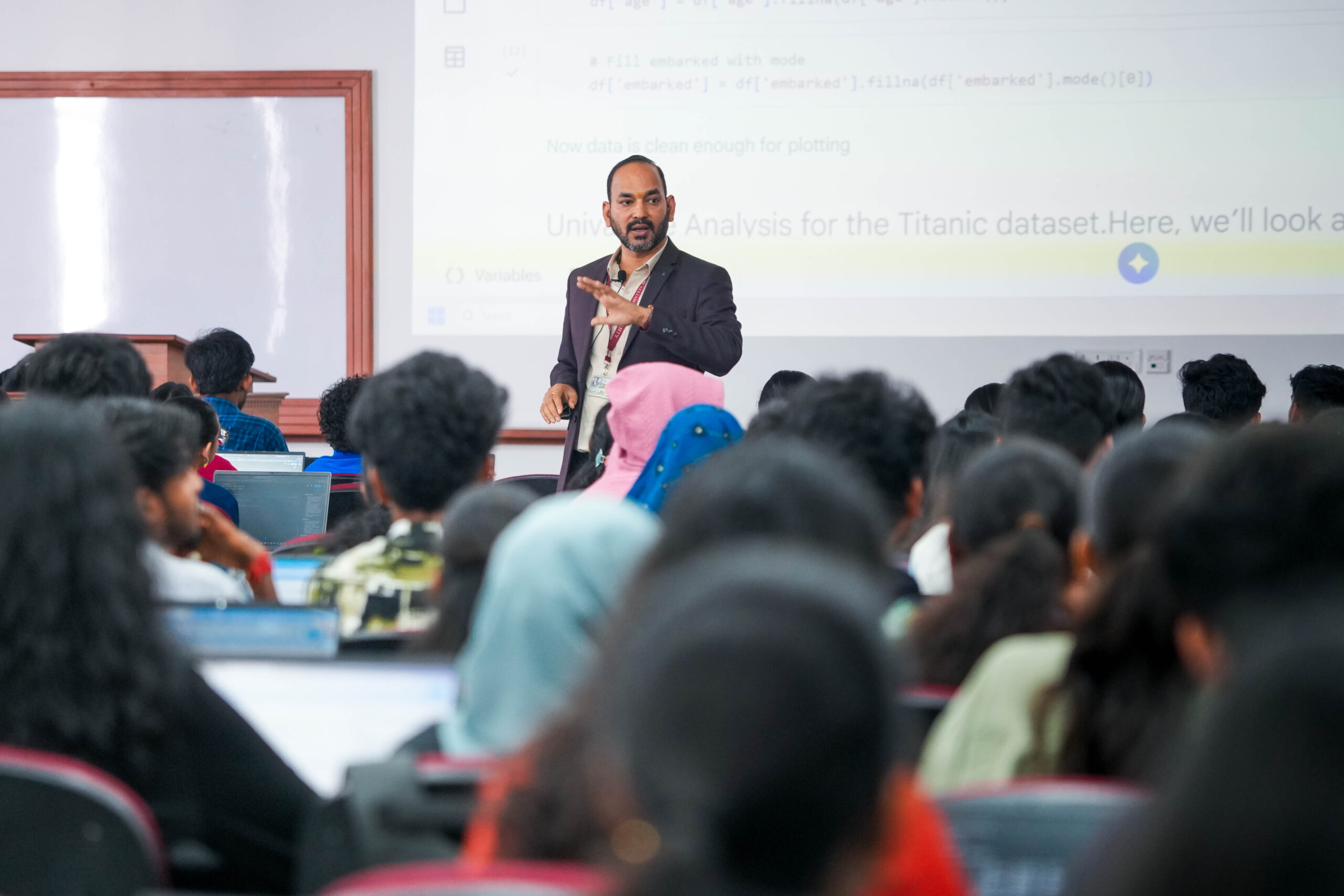
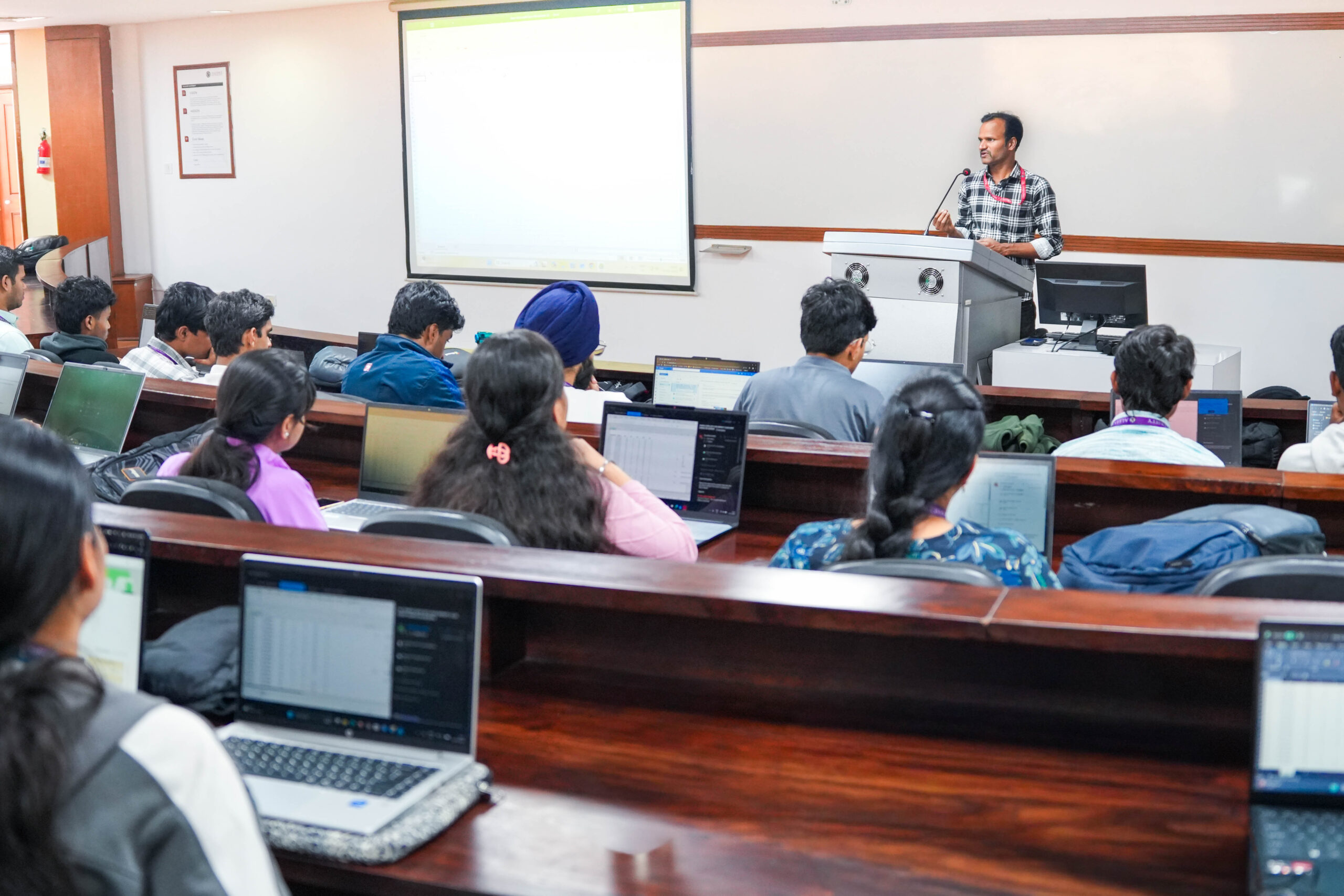
The MSc in Data Science is a comprehensive two-year (four-semester) postgraduate program designed to address the evolving demands of the global data-driven landscape. The program provides a strong foundation in statistics, programming, machine learning, and data management, while progressively advancing into specialized and emerging domains of data science and artificial intelligence. Built on a future-ready, industry-aligned framework with flexibility and interdisciplinary exposure, the curriculum emphasizes experiential and application-oriented learning through structured components such as experiential learning projects, research-driven capstone projects, and industry internships, enabling students to develop strong analytical and problem-solving skills. Students gain exposure to cutting-edge technologies including Artificial Intelligence, Deep Learning, Big Data Analytics, Natural Language Processing, and Data Visualization through elective tracks, domain-specific pathways, and industry-integrated modules. The program also incorporates emerging approaches such as no-code data science tools and cloud-based analytics platforms, complemented by industry certifications and skill enhancement courses that enhance technical depth and professional competence. Graduates are well-prepared to pursue diverse career pathways such as Data Scientists, Machine Learning Engineers, Data Analysts, AI Specialists, and Business Intelligence Professionals, along with opportunities in research, higher education, and data-driven entrepreneurship, emerging as versatile, future-ready professionals equipped to derive actionable insights and lead innovation in an increasingly data-centric world.

Why Choose
M. Sc. in Data Science
at Alliance University?
Supporting Features
Elite Pedagogy & Learning Spaces
World-class infrastructure and classroom activities.
Cutting-Edge Digital Academic Framework
Advanced digital learning platform.
Strategic Industrial Synergy & Practicum
Industry collaborations and internship.
Holistic Career Coaching & Placement
Career counselling and assistance.
Global Faculty Expertise & Mentorship
Experienced faculty experts with international exposure.

Machine Learning for Data Science
Mathematical Foundations for Data Science
Probability Distributions & Inferential Statistics
Data Modelling & Visualisation
Programming in Python
Experiential Learning Project
Research Methodology
IBM Data Science professional Certificate-1


Deep learning

Optimization Techniques for Data Science

Database Management & Warehousing

Data Structures and Algorithms

Elective- I (Track1 / Track2)

Capstone Project (Research)

IBM Data Science professional Certificate-2

Elective - II (Track1 / Track2)

Elective - III (Track1 / Track2)

No Code Applications for Data Science

Big Data Analytics

Internship/Capstone Project

Domain Specific Elective 1

Domain Specific Elective 2

Capstone Project

Electives

The Elective/Track System in the M.Sc. in Data Science curriculum is designed to provide students with focused specialization beyond the core subjects, enabling them to build expertise in high-demand and emerging areas of data science and analytics. Introduced from the second semester onwards, these electives allow learners to align their academic journey with career goals, industry trends, and research interests.

A key feature of this framework is the flexibility offered to students to choose from multiple elective tracks, empowering them to personalise their learning experience and explore interdisciplinary domains within data science.

Students can choose electives across two specialized tracks and domain-specific areas, reflecting the evolving landscape of data-driven technologies:

Track I: Artificial Intelligence and Deep Learning
Includes courses such as Computer Vision, Natural Language Processing, and Explainable, Responsible & Generative AI.

Track II: Data Engineering and Infrastructure
Covers areas like Cloud Computing, Streaming Analytics, and Machine Learning Operations.

Domain-Specific Electives
Students can further specialize through application-focused areas such as Smart Systems and IoT Analytics, Internet Crimes and Cyber Security, Supply Chain and Demand Forecasting, Business Analytics and Decision Science.

This structure highlights both foundational tracks and applied learning options.

The Elective/Track framework emphasizes:
a) Specialized skill development in advanced data science domains
b) Hands-on learning through labs, tools, and real-world projects
c) Integration of industry-relevant certifications and applications
d) Enhanced employability through focused domain expertise

By complementing the Program Core with targeted specialization, the Elective/Track system enables students to graduate with multi-dimensional competencies, making them adaptable, industry-ready professionals capable of thriving in dynamic, data-driven environments.

PEO (Program Educational Objectives)

PEO 1: Data Science post-graduates will demonstrate their knowledge in mathematical and statistical methods as problem solvers and researchers.

PEO 2: Data Science post-graduates will exhibit skills in advanced mathematical and statistical techniques to solve societal needs in multi-disciplinary areas.

PEO 3: Data Science post-graduates will develop an attitude towards lifelong learning of mathematics and statistics methods and ethics to emerge as socially committed professionals and/or entrepreneurs.

PSO (Program Specific Outcomes)

PSO 1: Data Science post-graduates will be able to apply data science tools and techniques to develop models in different disciplines with the help of advanced computing skills.

PSO 2: Data Science post-graduates will be able to develop solutions for complex real-life problems from different domains.

PSO 3: Data Science post-graduates will have the necessary technological skills and knowledge for serving current and future industry needs and/or for pursuing higher education in multi-disciplinary fields.

PO (Program Outline)

PO1 Complex problem-solving: The ability to use appropriate knowledge and skills to identify, formulate, analyse, and solve different kinds of problems in familiar and unfamiliar contexts and apply the learnings to real-life situations.

PO2 Critical & Analytical Thinking: The ability to apply analytical thought to a body of knowledge, to identify relevant assumptions and facts to formulate coherent arguments, and to analyse and synthesise data from a variety of sources and draw valid conclusions and support them with evidence and examples.

PO3 Research-Related Skills: The ability to identify, formulate, design, implement, and analyse research investigations. Design/Development of Solutions.

PO4 Digital & Technological Skills: The ability to use appropriate ICT tools for mathematical and statistical data analysis.

PO5 Learning How to Learn Skills: The ability to work independently, identify appropriate resources, acquire organisational and time management skills, and foster a temperament of lifelong learning.

PO6 Communication Skills: The ability to express thoughts and ideas effectively orally and in writing through different relevant channels and to different audiences.

PO7 Collaborative Skills: The ability to work effectively and respectfully with diverse multidisciplinary teams.

PO8 Creativity: The ability to think about problems through multiple perspectives and to develop innovative solutions.

PO9 Autonomy: The ability to work autonomously and take responsibility and accountability for their work.

PO10 Multicultural Competence & Inclusivity: The ability to understand the values and beliefs of multiple cultures, and to be sensitive to the needs of and to develop a conducive environment for empowerment of marginalised groups.

PO11 Empathy: The ability to identify with and understand the perspectives, experiences, and points of view of other individuals or groups, and to identify and understand other peoples’ emotions.

PO12 Multi- and Inter-Disciplinary Knowledge: The ability to apply and manage projects in a multi-disciplinary environment.

Program Core

The Program Core forms the foundation of the M.Sc. in Data Science curriculum, focusing on building strong analytical, mathematical, and computational skills essential for data-driven decision-making. It is carefully structured to ensure that students develop the ability to analyze data, build predictive models, and implement efficient solutions aligned with industry requirements.

This component includes key subjects such as Statistics, Probability Theory, Machine Learning, Deep Learning, Data Structures and Algorithms, Database Management Systems, Data Modelling and Visualization, Big Data Analytics, and Programming in Python and R. These courses are progressively delivered to ensure a smooth transition from fundamental concepts to advanced data science applications.

The Program Core emphasizes:
a) Problem-solving and analytical thinking
b) Data modelling and machine learning skills
c) Scalable data processing and optimization
d) Use of modern tools, frameworks, and technologies


With a strong focus on theoretical understanding combined with practical implementation, the Program Core prepares students for diverse roles in data science, AI, analytics, research, and innovation-driven industries.

The M.Sc. in Data Science curriculum incorporates a strong research-oriented component through structured academic elements such as Data Analysis Projects, Capstone Project, and Dissertation/Thesis Work, which collectively provide a comprehensive postgraduate research experience. These components enable students to undertake in-depth exploration of real-world data problems, advanced analytics, and innovation-driven solutions aligned with industry and societal needs.

Students engage in activities such as:

  • Problem formulation
  • Data collection and preprocessing
  • Exploratory data analysis
  • Model development
  • Validation
  • Interpretation
  • Creation of technical reports, research papers, and deployable data-driven solutions

The process is guided by faculty mentors and supported by access to advanced computing tools, datasets, and specialized labs or Centres of Excellence.

The dissertation experience emphasizes:

  • Research methodology and statistical analysis
  • Machine learning model development and evaluation
  • Data-driven decision-making and innovation
  • Technical documentation and scientific communication
  • Potential outcomes such as research publications, prototypes, and industry-ready solutions

This integrated approach ensures that students graduate with strong analytical, research, and practical skills, preparing them for doctoral studies, data science research roles, and advanced analytics careers in industry.

The Capstone Project is the culminating component of the M.Sc. in Data Science programme, enabling students to apply and integrate their learning to solve real-world data challenges. Typically undertaken in the final semester, students work individually or in teams to develop innovative, data-driven solutions.

The Capstone Project focuses on:
Advanced analytical thinking and problem-solving
Machine learning, AI, and data-driven innovation
Collaboration, project management, and professional practices
Application of data science techniques to real-world problems

Students build deployable models, scalable solutions, or research-based outcomes, which may lead to publications, prototypes, or industry applications. This experience strengthens their portfolio and prepares them for careers, research, and advanced studies in data science.

The Industry Internship Programme is an integral component of the M.Sc. in Data Science curriculum, designed to provide students with hands-on industry exposure and real-world experience in data-driven environments. Embedded within the academic framework, the internship enables students to apply theoretical knowledge in areas such as machine learning, statistics, and data analytics to solve practical, industry-relevant problems, thereby bridging the gap between academic learning and professional expectations.

Typically undertaken in the later stages of the program, the internship offers opportunities to work with leading organizations, startups, and research institutions across domains such as data science, artificial intelligence, business analytics, fintech, healthcare analytics, and emerging technologies. Students engage in live data projects, model development, collaborative team settings, and problem-solving tasks, gaining valuable insights into industry tools, workflows, and best practices.

The programme emphasizes:

  • Application of analytical and technical skills in real-world scenarios
  • Development of professional, communication, and teamwork abilities
  • Exposure to industry-standard tools, platforms, and methodologies
  • Enhanced employability through experiential and project-based learning

Guided by both academic and industry mentors, students are evaluated based on their performance, project outcomes, and professional conduct, ensuring a structured and meaningful learning experience. This internship component plays a crucial role in preparing students for careers in data science, research, consulting, and innovation-driven roles.

To further strengthen industry readiness, the programme is designed with a flexible academic schedule. The odd semester is planned to commence early, from the month of May. This structure allows students to dedicate the subsequent period to full-time internships, enabling them to gain extended industry exposure, practical experience, and professional networking opportunities before completing the programme.


STUDY ABROAD OPTIONS

International Mobility

Experience global education through our international study opportunities designed to broaden academic perspectives and cultural understanding. These programmes enable students to study at partner universities abroad, gain international exposure, and develop the global competencies needed to succeed in an interconnected world.

Learn More

An opportunity that lets students begin their degree at Alliance University (1 or 2 years) and then transfer to a foreign university to complete and earn their degree internationally.

Explore the World: Study a semester abroad, earn transferable credits, and gain global insights while experiencing a new culture and expanding your skills.

An exciting immersion opportunity for Alliance University students to engage with leading multinational companies and innovative startups, offering a unique blend of global learning and practical work exposure abroad, all within just 7 to 14 days.
Short-term programmes lasting 2 to 4 weeks offer students an ideal opportunity to gain international exposure without disrupting their academic schedule.

Learn More

Alliance University welcomes students from across the world to study, collaborate, and thrive in a truly global learning ecosystem. We combine academic rigour with industry exposure, modern infrastructure with personalised support, and global perspectives with Indian values.

Learn More

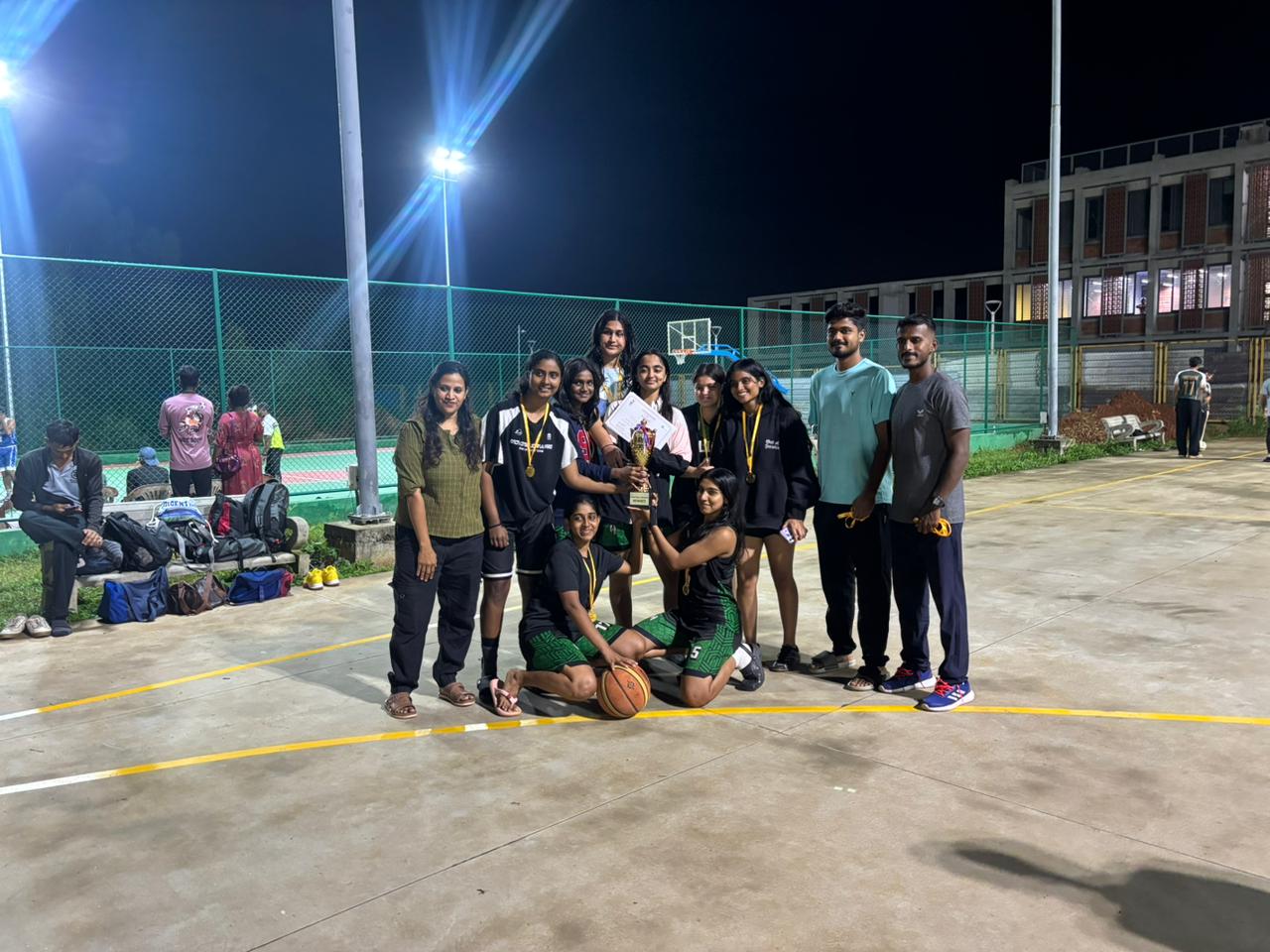
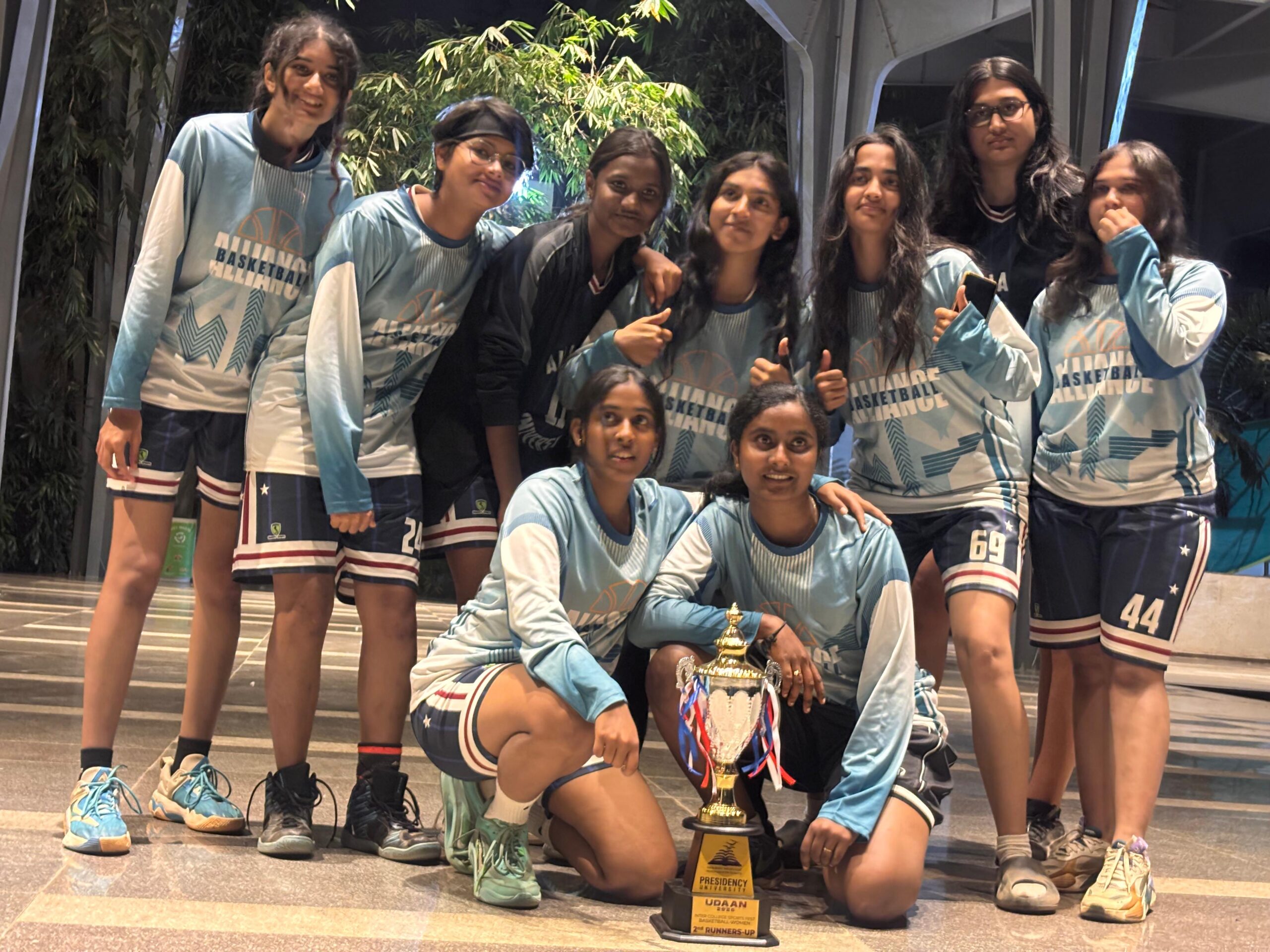
Recognising Effort, Celebrating Success

Category Eligibility Criteria
General Bachelor’s degree in Science (Statistics / Mathematics / Computer Science) or Engineering (B. Engg / B. Tech) with minimum 50% aggregate from a recognized university
Reserved Categories 5% relaxation for SC / ST candidates


Program duration

Entry Level Program Duration
Entry Level Two Years / Four Semesters


ACCEPTED TEST SCORES
SAT
AUSAT
SAT
AUSAT
SAT
AUSAT
SAT
AUSAT

Particulars Indian Nationals Foreign Nationals
Registration Fee / Fee for Learners Value Proposition Course (Virtual) ₹25,000 $500
1st Installment (As per provisional admission offer letter) ₹1,75,000 $2,250
2nd Installment ₹2,00,000 $2,750
Total Program Fee ₹4,00,000 $5,500


Category Eligibility Scholarship
SC / ST X & XII ≥ 60% + National Level Entrance Test ≥ 70% 20% Tuition Fee Waiver
Differently-Abled X & XII ≥ 50% 50% Tuition Fee Waiver
Defence & Paramilitary X & XII ≥ 60% + National Level Entrance Test ≥ 70% 15% Tuition Fee Waiver
International-Level Player X & XII ≥ 50% 100% Tuition Fee Waiver
National-Level Player X & XII ≥ 50% 50% Tuition Fee Waiver
Domicile X & XII ≥ 60% + National Eligibility Criteria Met 5% Tuition Fee Waiver
Policy Scholarships are awarded on a first-come-first-serve basis. Terms & conditions apply.
Learn more


Steps Description
Step 1 Submit Online Application
Step 2 Pay Application Fee — ₹1000 (US$50 for foreign nationals)
Step 3 University Entrance Test & Academic Evaluation
Step 4 Oral Extempore Presentation
Step 5 Personal Interview & Profile-Based Selection
Start your application now

Living Spaces That Inspire Belonging

EXPLORE OUR HOSTELS

Comfort, safety, and community form the foundation of campus living. Our residential halls are thoughtfully designed to create a sense of belonging—offering a welcoming environment where students can study, unwind, and build lifelong friendships.

Separate hostels
for boys and girls

Student-friendly
common areas

Spacious rooms
(single, double, or triple occupancy)

Dedicated wardens
and support teams

residential-image-update

Real Stories, Real Impact

FACULTY
STUDENT

I am currently pursuing my M.Sc. in Data Science at Alliance University, and my experience has been nothing short of exceptional. The curriculum is robust, keeping pace with the latest industry trends, and the faculty is comprised of experienced professionals who are not only experts in their fields but also deeply committed to student success. The dynamic learning environment with state-of-the-art facilities fosters both theoretical understanding and practical application. The emphasis on hands-on learning, industry projects, and internships have greatly enhanced my skill set and prepared me for the challenges of the data science landscape.

Akhil
Batch: 2023-25

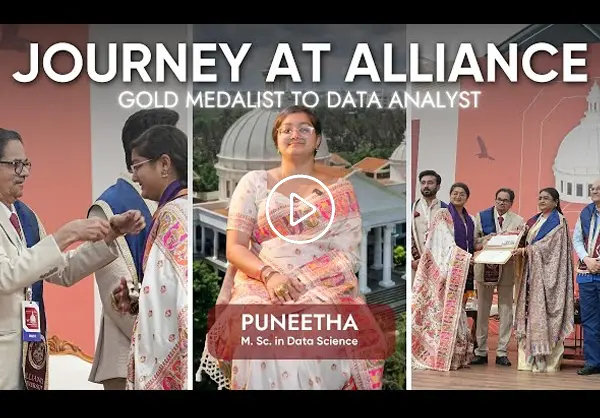
The M.Sc. in Data Science programme at Alliance University is a fulfilling experience. The vibrant campus, dedicated faculty, and diverse student community have created an enriching learning environment. The well-rounded curriculum and emphasis on practical skills have prepared me for the professional world. I am grateful for the opportunities and growth I’ve experienced during my time at Alliance University.<?p>

Puneetha
Batch: 2023-25


Puneetha
Puneetha

Everything You Need to Know

What are the eligibility criteria for admission to an M. Sc. in Data Science programme in India?
To enrol for an M. Sc. in Data Science programme at Alliance University, the eligibility criteria are a bachelor’s degree in Science (Statistics, Mathematics, or Computer Science) or Engineering (B. E. or B. Tech.) from a recognised university with a minimum of 50% marks. A relaxation of 5% is applicable for SC/ST/OBC and Differently Abled candidates.
What career opportunities are available after completing an M. Sc. in Data Science?
Graduates can pursue roles such as Data Scientist, Machine Learning Engineer, Data Analyst, Data Engineer, Business Analyst, BI Developer, Data Architect, Applications Architect, and Data Solutions Analyst across industries like finance, healthcare, and technology.
What is the duration and structure of an M. Sc. in Data Science programme?
The programme is a two-year postgraduate degree covering core subjects like Data Visualisation, Machine Learning, Data Mining, Statistical Modelling, and Data Management. Electives include Deep Learning, NLP, Big Data Analytics, and Data Ethics. It also includes projects, internships, industry exposure, and soft skills training.
Are there internships or industry projects in an M. Sc. in Data Science programme?
Yes. The CAN (Career Advancement and Networking) department provides internships, industry projects, and mentorship opportunities to help students gain real-world experience.
How does an M. Sc. in Data Science differ from an M. Tech. in Data Science?
M. Sc. focuses on statistics, mathematics, machine learning, and data-driven decision-making, while M. Tech. is more engineering-oriented, focusing on algorithms, programming, and system-level implementation. M. Sc. is typically research-oriented, while M. Tech. is more technical and engineering-focused.
How does an M. Sc. in Data Science support global career opportunities in tech?
The programme builds strong skills in programming, statistics, machine learning, and communication, enabling careers in data science, AI, finance, healthcare, and technology across global markets. Students gain hands-on experience through projects and industry exposure.
What entrance exams are required for M. Sc. in Data Science admission in Alliance University?
Applicants must submit an online application, followed by an aptitude test and a personal interview as part of the admission process.
Are scholarships available for M. Sc. in Data Science students at Alliance University?
Yes. Scholarships are available for eligible students. Details can be found on the official scholarship page.
What practical learning opportunities are offered in the M. Sc. in Data Science programme?
Students gain practical exposure through internships, hackathons, case studies, industry projects, and capstone projects using modern data science tools and technologies.
Is the M. Sc. in Data Science programme suitable for aspiring data scientists?
Yes. The programme equips students with core skills in Python, R, SQL, machine learning, and data visualisation, preparing them for roles like Data Scientist, Data Analyst, and Machine Learning Engineer.
How does Alliance University’s faculty enhance the M. Sc. in Data Science experience?
Faculty members come from premier institutes like IITs, IIMs, and NITs, and include internationally recognised researchers. They bring strong academic and industry experience to enrich learning.
How can I connect with current M. Sc. in Data Science students or alumni at Alliance University?
You can connect through the TAP platform, alumni network of 32,000+ members, and university events such as open houses, seminars, and student interactions.
How does this programme integrate theory with practical learning?
The programme blends theoretical foundations with internships, industry projects, case studies, lab work, and mentorship to ensure applied learning.
Does the University provide career counselling and placement support for Data Science graduates?
Yes. The CAN department provides placement training, career counselling, workshops, seminars, live projects, and networking opportunities with industry experts.
What is the fee structure of the M. Sc. in Data Science programme?
The total programme fee is approximately ?4 lakhs for two years (excluding hostel fees), payable in instalments. Detailed fee information is available on the official fee structure page.
What is the M. Sc. in Data Science program? +

A two-year postgraduate program providing advanced training in statistics, AI, machine learning, big data analytics, and applied programming.

What is the course duration? +

Two Years (Four Semesters)

What is the eligibility criteria? +

Bachelor’s degree in Science or Engineering with 50% aggregate; relaxation applies for reserved categories

Does the program include practical experience? +

Yes — labs, case studies, projects, and industry-linked learning components

What skills will I gain? +

Data analytics, programming, AI modelling, problem-solving, research methodology, and applied statistics

Are internships supported? +

Yes, through industry collaboration and placement assistance

What career paths are available? +

Data Scientist, AI Specialist, Business Analyst, Statistical Modeler, ML Engineer, Research Analyst, and more

Are mentorship and career services provided? +

Yes — structured mentorship and dedicated career counselling

Can international students apply? +

Yes, subject to admission policy

AU